
Thanks to Louise Wickham for additional archive references and to Susan Latter for her help with Jackson and Scruton history.
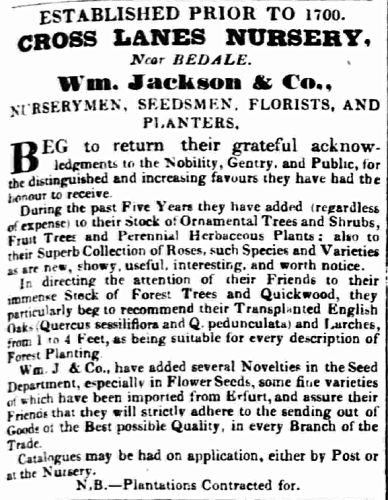
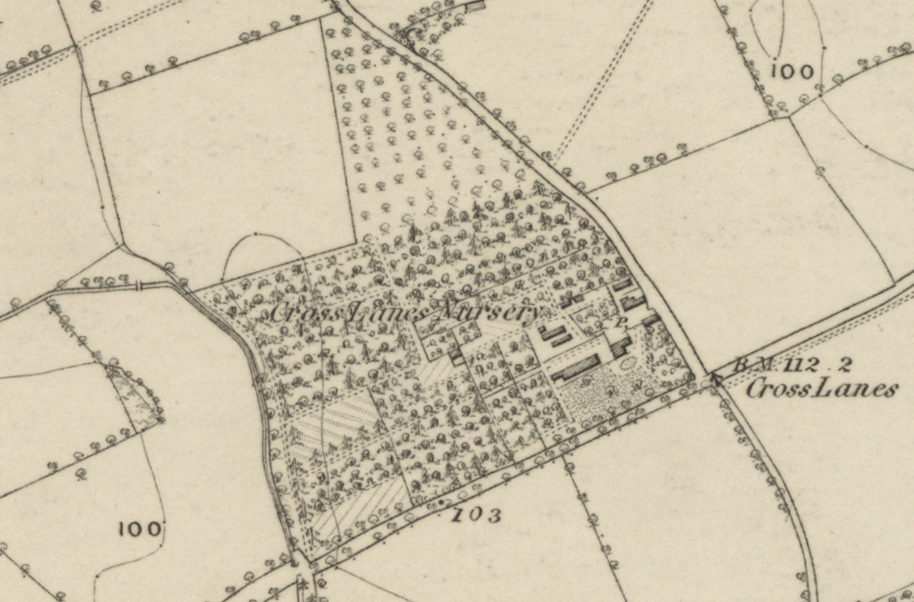
Nineteenth century maps show Cross Lanes nursery to be situated in the parish of Scruton in North Yorkshire on the junction of the road from the village and the main road from Northallerton to Bedale. A farm also known as Cross Lanes lies on the opposite side of the main road. William Jackson of Cross Lanes is mentioned in Hadfield’s History of British Gardening (1960, 333) as active in the 1840s. However a newspaper advertisement for the nursery in 1842 is proudly headed ‘established prior to 1700’ (York Herald, 8 January 1842). So what more can be learnt about this Yorkshire nursery and the Jackson family?
The Jackson family were freeholders in Scruton since at least the late 17th century. According to a note in the Parish Register transcripts (Preston 1991, 170), John Jackson ‘of Crossgate’ and his wife Friswith were the first of the family to live at Cross Lanes. Whether or not John set up a nursery business is not established but on his death in 1700 he left his land in Scruton to his son Thomas 1 (NYA ZZF 1.2.2) who was clearly involved in raising trees. He was paid £6 8s 4d for the sale of 160 fir trees to Studley Royal in 1716-26 (WYASL WYL150/5507 285/2) and in 1727 he supplied 180 Scotch firs to Baldersby Park (Furse 2023, 56). It is tempting to speculate that he might also have been involved in the planting at Scruton Hall, built by Roger Gale in 1705 (https://www.scruton.net/heritage/ accessed 27/11/25).
Between April 1747 and July the following year Thomas and his son Thomas 2 carried out more than 200 days work for William Aislabie at Kirkby Fleetham, charging 2s a day for himself and 1s for his son. They supplied and presumably planted a variety of trees - 123 elms, 157 firs, 25 oaks, all at 6d each. He suppled 3500 quick sets at 5s a 1000 and 7 trees, possibly walnuts, at a shilling each. He also charged for the use of his cart for 32 days at 1s 6d a day (WYASL WYL150/5619/B/2/23)
Thomas’ son, Thomas 2, inherited Cross Lanes on his father’s death in 1767 and continued the nursery business supplying the Gisborough Estate with ‘young trees’ in 1796, 1797 and 1799 (NYA ZFM 87). In 1801 he was contracted to plant 2 parcels of land for Lord Ailesbury at No Mans Moor, near Newton-le-Willows with 3,000 trees, maintain them and replace any that died for a period of 3 years (NYA ZJX 7/46/34). This gives an idea of the scale of the nursery business at this time and the trees he was raising - larches, scotch firs, spruce, silver firs, oaks, ashes, beeches, elms, sycamores and birch. In May 1802 Timothy Hutton of Clifton Castle first mentions his dealings with the business: ’Paid Mr Jackson, gardener at Cross Lane 15/3/-‘ (NYA ZAW).
When Thomas 2 died aged 80 in 1805 he owned Cross Lanes Farm and the Nursery, which he left to his two older sons, Thomas 3 and William, with the stipulation that if one died without issue, their half of the nursery would revert to the other (NYA ZZF 1/2/2). Another Scruton estate was left to his son Jacob. Thomas and William initially managed the nursery together and both are described as ‘nurseryman’ on parish records. In October 1805 they were approached again by Lord Ailesbury for an estimate for tree planting. Both sign the letter requesting permission to view the land, stating ‘we have a large assortment of trees for this season we can afford to plant on very modest terms’ and quoting £3-4 per acre as a guide (NYA ZJX 7/58/19). In 1806 Thomas was paid £109/18/- for tree planting by Timothy Hutton (NYA ZAW) but it is uncertain what happened to him subsequently. He may have died early without issue as William appears to be in sole charge of the business in the following decades and the nursery is listed under William’s name in Baines directory of 1823.
In 1817, William Ward-Jackson of Normanby Hall noted William Jackson’s advice on planting hollies in his diary:
‘Mr William Jackson Nursery man of Cross Lanes near Bedale told me he thought the End of May or beginning of June (according to the Season) the best time for planting hollies, to water them, & then cover them thinly with Straw which may remain on them, a Month, till they have evidently taken root & are growing’ (Teesside Archives U/WJ 21).
Between 1816 and 1836 Timothy Hutton spent upwards of £100 at Jackson’s nursery on various occasions, buying trees, shrubs and garden seeds. In November of 1836 he ‘stopped to look at Jacksons trees’ on a visit to Scruton. However, William died in December of that year but, in January, Hutton arranged with his son, also William, for a new plantation at a rate of £3/10/- an acre (NYA ZAW).
When William senior died in December 1836, he was a man of substance and property. His newspaper obituary said he was of
‘upright and honest principles, a kind and indulgent parent and his loss will be deeply lamented by a numerous circle of friends and the poor of the neighbourhood’ (Yorkshire Gazette, 31 December 1836).
It is possible that he built the early 19th century Scruton House on the site (NHLE 1150894, Grade II) and his will refers not only to Cross Lanes but also other properties in Scruton and elsewhere. He left all his ‘share’ of the Estate of Cross Lanes along with other land to his eldest son William, other property being left to his second son Thomas. However the nursery stock - ‘all the young Forest Trees, Fruit Trees and Shrubs that may be growing on my said Estate at Cross Lanes’ was left to his two sons William and Thomas ‘share and share alike’ (transcript from S. Latter).
From this time records are more plentiful and show the nursery as expanding and prospering. William junior was listed as a ‘nurseryman’ in Whites directory of 1840, and on the 1841 census, as was his uncle Jacob Jackson. The 1839 tithe records showed that William owned several other nursery or plantation plots in Scruton as well as Scruton house and nursery ground at Cross Lanes. In 1851 William employed 6 men and by 1854, when the 1st edition OS 6” map was surveyed, the main site extended to the north, a nursery ground probably inherited from his uncle Jacob who died in 1846.
The advertisement of 1842, referred to at the beginning of this article shows that William junior continued to cater for the estates of the landed gentry, raising trees including larches and English oaks (Quercus sessiflora and pedunculata). In addition they grew hollies, elms, spruce and limes ‘for avenues and park trees’ (York Herald, 8 January 1842; Yorkshire Gazette, 23 December1843). In 1846 they were advertising ‘a few thousands of Highland pine so much recommended in ornamental planting’ (York Herald 21 February 1846). They sold forest trees worth £118s to Goldsborough Hall in October 1849 (WYASL WYL250/3/ACS/218) and in 1858 they supplied shrubs and trees worth £144 for plantations to Gisborough Hall ('Mansion Acct', NYA ZFM 93).
The 1842 advertisement also shows William was expanding the range of his stock, listing ‘ornamental trees and shrubs, fruit trees and perennial herbaceous plants: also…their superb collection of roses’.
He was importing seeds, particularly for flowers, from Erfurt in Germany which had been a centre for horticulture since the 18th century and was known for flower and vegetable seeds in the 19th century (https://www.erfurt-tourismus.de/en/all-about-erfurt/horticulture/horticultural-heritage/ accessed 26/1/25).
Fruit trees advertised in 1866 included 5-6ft standard apple pear plum and cherry trees and Moorpark apricot at 12s a dozen. Peach and nectarine trees were 18s a dozen and currant and gooseberry bushes 1/6 to 2/- a dozen (Richmond & Ripon Chronicle, 3 February 1866).
The facilities of the nursery included a greenhouse nearly 50ft long for raising and displaying their plants (York Herald, 6 July 1844).
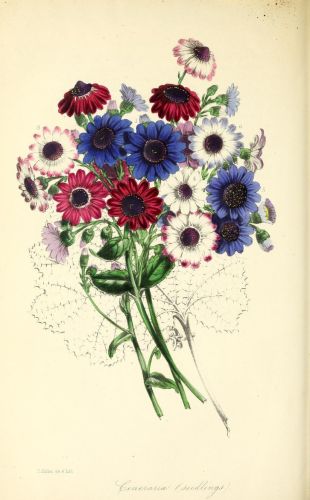
Calceolaria, fuchsias and hyacinths were all advertised in the 1840s with the hyacinths imported from Haarlem and retailed at 3-9s a dozen (York Herald, 5 October 1844). In 1847 they announced their unrivalled new Cinerarias:
‘now in full bloom…grouped with the choicest exotics from all parts of the world, they form a pleasing and most brilliant effect through the whole length of their extensive greenhouses’ (York Herald, 8 May 1847).
In 1873 a display of 500 camellias was exhibited in their conservatory at the nursery (Yorkshire Post and Leeds Intelligencer, 15 February 1873).
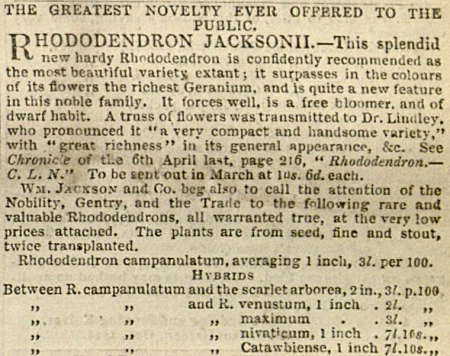
Rhododendrons were a specialty. William Jackson is credited with raising an early flowering red Rhododendron ‘Jacksonii’ (Hadfield 1960, 333). He was selling ‘Jacksonii’ plants for 10/6 to 63/- in 1845 and in 1861, they were offering ‘R. Nobleanum, Jacksonii and varieties, including scarlet, crimson, blush and shaded salmon' . The price was then £5 a hundred (Rhododendron: The Hybrids / Rhododendron Hybrids', treesandshrubsonline.org/articles/rhododendron-the-hybrids-rhododendron-hybrids/, accessed 10/11/2025).
The growth in popularity of horticultural shows during the nineteenth century provided an opportunity to promote their company and show what they were growing. In 1844 the nursery exhibited Erica Ventricosa Superba (Wax Heath), Formosa Elegans (a variety of fuchsia) and 18 varieties of roses at the North Riding show as well as offering a premium for the best 12 varieties of roses (Yorkshire Gazette, 3 August 1844). On their first visit to the York Horticultural Society in 1845 their Begonia Coccinea plant attracted notice and they carried off ‘several valuable prizes’ for Cineraria, climbers, stove and greenhouse plants, and a specimen of Rhododendron Nivaticum was noted at a subsequent meeting (York Herald, 3 May 1845; York Herald, 31 May 1845). Roses and yuccas gained prizes in 1879 at the 21st Grand Yorkshire Gala (York Herald, 21 June 1879)
Censuses, directories and newspaper advertisements show that the Cross Lanes nursery under William’s ownership continued trading through the 19th century. He also had farming interests and wrote an essay on converting arable to pasture land which was reported to the Richmondshire Agricultural club (York Herald, 7 December 1844). The nursery stocked agricultural supplies such as turnip seed. One variety was named Jackson’s Golden Drop (probably a swede), available from agents across Yorkshire, the North East and London (York Herald, 16 May 1846). On the 1871 census, William was described as a farmer of 85 acres, employing 6 men, as well as being a nursery and seedsman.
William married late, in his 70s, and died in 1901, leaving a daughter of 12 and young son of 8. His widow moved back to Leeds, her birthplace, after 1911. With no immediate successors the nursery was run by Henry Robinson as a market garden. Both the 1911 and 1921 censuses show Robinson living in a smaller house on the nursery site but they had moved on by 1939. Scruton House itself may have remained in the family’s possession and been rented out, as descendants of William’s younger brother had returned there by 1939 and were still living there in the 1970s (S. Latter pers. comm) by which time maps no longer marked the nursery.
References / Bibliography
Furse J. et al 2023, Baldersby Park: The History of a House. Topcliffe, Queen Mary’s School,
Hadfield, M., 1960 A History of British Gardening Spring Books
Preston, C.S. ed, 1991 The Parish Register of Scruton 1572-1837 Yorkshire Archaeological Society
NYA - North Yorkshire Archives
ZAW Temporary deposit: Timothy Hutton’s diaries and accounts
ZFM Chaloner (Lord Gisborough) Archive
ZJX Jervaulx Abbey estate Records
ZZF Papers and notes of Cyril Preston relating to the History of Scruton
WYASL - West Yorkshire Archive Services, Leeds