Whilst only a modest designed landscape covering 100 acres at its greatest extent, the grounds around Skelton Hall still provide an appropriate setting for the Grade II listed hall that was built c. 1806-8. The carefully planned layout of the pleasure grounds, large pond and wider parkland was attributed to Mr Mickle by John Kilby who built the hall. This was probably Adam Mickle II or his son, also Adam, who had joined him in his landscape practice at this point. Kilby never lived at Skelton and it is possible some of the design could be by later tenants or owners. These included Mrs Mary Thompson, whose husband had employed Mickle at his Kirby Hall estate and was resident from 1814 to 1840 or William Thornton Duesbury who remodelled the hall in the 1840s.
Estate owners
In 1630 the land later occupied by Skelton Hall was in the possession of Thomas Atkinson, who transferred it to Thomas Lovell in 1633. Lovell had mortgaged his estate at Skelton to James Brooke, who took possession in 1657 and it remained in the Brooke family until the death of Honora Jenkins (née Brooke) in 1778. Her estate at Skelton was sold in 1783 to Joshua Hepworth, Mary Place and John Nodes. By 1787, Thomas Kilby of York had acquired lands at Skelton including part of the grounds that would become Skelton Hall. Thomas died in 1792 and his property at Skelton was left to his eldest son, John, who acquired further land there and built Skelton Hall. He then rented it out to Mrs Mary Thompson from 1814, who retained the lease following Kilby’s bankruptcy in 1819. The estate was sold to William Thornton Duesbury in 1839, who lived there until 1857. The hall and grounds were then sold to William Battye and his family continued to own the site until 1949, although after William’s death, it was rented out. The property was split in two in 1953 but became one building again in 1997.
Key owners or tenants responsible for major developments of the designed landscape and dates of their involvement:
John Kilby c. 1806 – 9
Mrs Mary Thompson 1814 – 40
William Thornton Duesbury 1840 – 57
William W. Battye 1857 – 69
Early history of the site
The Skelton Hall estate was on land adjacent to the manor house and a map from 1630 (NYA ZDV/V/15) described it as ‘Atkinsons land’. Thomas Atkinson had acquired it in 1628 from William Beseley (VCH 1923, 168), whose parents, Edward and Bridget, had built Skelton manor house in the late 16th century. The c. 5 acre site of the later hall and pleasure grounds may have been the ‘Hall garth’, an enclosure or garden attached to the manor house, possibly with the extant pond. Atkinson’s daughter married Thomas Lovell junior in 1635 and their marriage settlement of the 6 April 1633 included the manor of Skelton with messuages and lands (BIA PL/70). The Lovell family already had land in Skelton, formerly belonging to St Mary's Abbey of York, that Henry VIII granted them on 14 May 1545 (BIA PL/13). In 1654, Thomas Lovell senior and junior sold the manor house and their lands at Skelton to James Brooke of York (BIA PL/18).
James Brooke died in 1675 and Skelton passed to his son, John, but like his father lived at their other Yorkshire estate of Ellenthorpe. Sir John Brooke was succeeded by his son, Sir James, in 1691 and grandson, Sir Job, in 1735. The Skelton lands were used as collateral for mortgages and by 1778, the sum owed to creditors amounted to £3,500 with interest (BIA PL/47). With the death of Honora Jenkins (cousin and heir of Sir Job Brooke), the Skelton estate was put up for sale in 1782 following a decree in Chancery (NYA ZDA.DAR TD/139-40). On 6/7 November 1783, Joshua Hepworth of Barnby on Dun bought the manor of Skelton with capital messuage and other messuages, cottages and closes of land for £17,100 (BIA PL/49-50). Earlier that year, he made an agreement with Mary Place of Pudsey and John Nodes of Skelton to divide the estate he had bought from the executors of Honora Jenkins (BIA PL/48).
Chronological history of the designed landscape
1787 – 1857
On the 7 August 1787, land was put up for sale in Skelton covering a block of 585 acres together with ‘several detached parcels of land, in different parts of Skelton’ (Leeds Intelligencer, 24 July). It is possible that this is when Thomas Kilby of York acquired his land there. In his will written on the 10 November of that year, he referred to his ‘estates at Skelton’ that included the Mill House with 37 acres (TNA PROB 11/1218/220). The enclosure map of 1807 (NYA I Skelton) showed the land owned prior to the enclosure and the subsequent exchanges. Thomas’ son, John, who inherited his lands at Skelton in 1795, had a small area of c. 45 acres to the south next to the river (Figure 1) that was the Mill House and specific lands referred to in his father’s will.
He had though a larger area to the north of c. 130 acres, of which 13 acres was acquired by exchange including c. 6 acres that would be the site of Skelton Hall and gardens (Figure 2). The latter area had been the property of Roger and John Barker, who acquired it from William Wilberforce MP in 1799 (NYA NRRD CQ 592 851) and is described in the enclosure award (NYA NRRD DA 31 93) as a ‘Homestead and Garth’. In the deeds, there are references to messuages and other buildings (NYA NRRD CQ 592 850), although whether these were still in place by 1806 is unclear. A building is marked on the enclosure map in the location of the hall, so John Kilby must have started building it. Why Kilby did so is not known as he appears never to have lived there, instead staying in York perhaps to be close to his brewing business there. The house (then known as Skelton Lodge), ancillary buildings and grounds were complete by 1809, when Kilby offered it for rent:
‘Skelton Lodge, situate four miles from the City of York, on the high North Road, consisting of a spacious Drawing and Dining-Room, Library, and Breakfast-Room, Kitchen, Scullery, Butler’s Pantry and Servants Hall, on the ground floor; six lodging rooms on the second floor and servants’ rooms above; together with a double coach-house, granary, stables for eight horses, cow-house, piggery and stackyard, a good Garden walled in (south wall flued) and planted with choice fruit trees, with pleasure grounds, half a mile in length, laid out by Mr. Mickle and a fishpond, well stocked with tench. A suitable quantity of good meadow and pasture land may be had, to accommodate a tenant…J. Kilby, Esq. the Owner’ (York Herald, September 9)
The pleasure grounds would have included the area around the hall and some of the former fields to the east. The designer was likely to be Adam Mickle II (c. 1747-1811) or possibly his son, also Adam, who took over his father’s landscape design practice. The 1st edition 6” OS map surveyed from 1848 to 1852 (Figure 3) gives some indication of the likely layout of the gardens planned by Mickle. The extent of the planned parkland is more problematic, as at the time of the enclosure Kilby only owned just over 30½ acres there (Figure 2). It is possible that he acquired the southern section belonging to Roger and John Barker following the enclosure. However in 1813, Skelton Lodge was once again up for rent with the hall being offered with just ‘15 acres of land, ornamental shrubbery, fish pond…[and] kitchen garden’ (York Herald, 21 August).
The new tenant was Mrs Mary Thompson and she would live there until the property was acquired by William Thornton Duesbury in 1840 (Yorkshire Gazette, 23 May). Mary was the widow of Henry Thompson, who had reshaped the grounds at Kirby Hall. John Kilby filed for bankruptcy in 1819 and most of his assets were put up for public sale by his creditor bank (London Gazette, 24 August). The exception was Skelton Lodge and its grounds that was retained by the bank. Mrs Thompson remained the tenant and it is possible that she made changes to Skelton, including adding a greenhouse to the southwest of the hall. This is shown in a drawing of the south front and immediate grounds of Skelton Lodge by F.H. Abraham of c. 1839 that is inscribed to Mrs Thompson (Explore York Archives PHO/3/281).
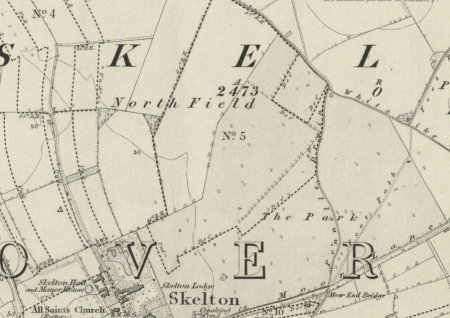
On buying Skelton Lodge, William Thornton Duesbury made changes to the house in the summer of 1840 (York Herald, 5 September). Whether he made any changes to the grounds is not known but in December 1841, he became the President of the York Horticultural Society (Yorkshire Gazette, 11 December). By 1852, the parkland had expanded to cover c. 90 acres with the addition of the land to the south (Figure 4). By this stage, the house became known as ‘Skelton Hall’ although the name ‘Skelton Lodge’ persisted for some time. Duesbury did not stay long at Skelton Lodge and by 1857, William W. Battye was the new owner.
Later history
William Battye died on 30 March 1869 and following his wife’s death in August of that year, Skelton Hall was offered for rent:
‘Skelton Hall, near York. To be let, furnished, for a term of years, the above capital mansion…together with pleasure grounds, about five acres; hot houses, two kitchen gardens, stabling for nine horses and other outbuildings; 20 acres of grass land, and the shooting over 500 acres’ (York Herald, 18 September).
The Skelton Hall estate had passed to his son, Richard, who only outlived his father by 4 years. However he had rented out Skelton to John Austin in 1871, who stayed there until c. 1879, when Richard Battye’s widow, Frances, sold the contents of the hall and also ‘greenhouse plants and outdoor effects’ (York Herald, 6 September). The hall though continued to be rented out with the new tenant being Thomas Newton, who lived there until 1885. The grounds appeared to have been maintained as an advert in 1888 noted its ‘excellent well-stocked pleasure grounds, with greenhouses and good kitchen garden, containing in the whole an area of 5a 3r, with…21 acres of good grass land’ (York Herald, 7 July). These are shown in the 1st edition 25” OS map that was surveyed in 1891 (Figure 5). Despite some changes to the hall itself in the mid-20th century, the pleasure grounds are largely intact and the former parkland remains an open green space as a suitable setting for the hall.
Location
Skelton Hall lies 3.5 miles (5.5 km) northwest of York.
Area
The designed landscape at Skelton Hall covered c. 100 acres at its greatest extent in the mid-19th century.
Boundaries
The northern boundary starts at the northwest corner of the pleasure grounds at SE 568 567 and follows the northern edge of the parkland to the White Sike Drain at SE 573 573. The eastern boundary then continues south from here following the drain until SE 576 571 when it goes south to Moor Lane at SE 578 568. The southern boundary continues from there along Moor Lane until it reaches Crooking Pond at SE 571 565. The western boundary starts at the southwest corner of the parkland at SE 570 565 before going north to the southeast corner of the kitchen garden. It then follows the western extent of the pleasure grounds north to SE 568 567.
Landform
The underlying geology at Skelton Hall is sandstone (Sherwood Sandstone Group) with superficial deposits of sand and gravel. This is covered by slowly permeable, seasonally wet and slightly acid but base-rich loamy and clayey soils.
Setting
Skelton is in Landscape Characterisation Area 28 – the Vale of York, typified by relatively flat low-lying land that is predominantly agricultural. It is surrounded by higher land from which water drains through its numerous rivers and streams to the area, creating a wet, fertile land. The hall is at 22m AOD and the pleasure grounds are broadly flat north to south. The parkland falls away west to east from 20m OD next to the hall to 13m OD at White Sike Drain.
Entrances and approaches
The entrance to the estate is via a gateway from the lane opposite the church, with a short carriageway northeast to the south front of the hall.
Principal building
Skelton Hall [Grade II – NHLE 1296235]
Built c. 1806-8, it was modified in the mid-19th and mid-20th centuries.
Gardens and pleasure grounds
Probably designed c. 1806-8 by Adam Mickle, these covered c. 5 acres. The central feature in the northern section was the pond and it was surrounded initially by shrubbery and some trees. By the end of 19th century, it was more heavily wooded to the west but to the east there was an open area with a central path leading from a terrace next to the hall to a garden building to the north (Figure 5). The whole area was surrounded on the north and east by a haha.
Kitchen garden
Built c. 1806-8, it is the southeast corner of the pleasure grounds and the walled section covered 0.25 acre with an additional area to the east of 0.076 acres. The south wall had flues that meant it could be heated and it was planted with fruit trees. A greenhouse was added in the northeast corner of the walled section between 1852 and 1869 (Figure 5). By 1967-8, it was in separate ownership with a house built in its interior although the glasshouse was extant (Figure 6).
Park and plantations
Covering just under 100 acres in the mid-19th century, the parkland was planned but perhaps not executed by Adam Mickle c. 1806-8 as John Kilby did not own all the land at the time. By 1907, it had reduced to just over 61 acres and is now open farmland.
Water
The date of construction of the extant pond is likely to be c. 1806-8, although it is possible there was some form of water there previously. It covered about ½ acre with a central island but by 1967-8, it had been reduced to c. ⅓ acre.
Books and articles
VCH 1923. A History of the County of York North Riding: Volume 2. London, Victoria County History.
Primary sources
Borthwick Institute for Archives, University of York (BIA)
PL/13 Letters Patent from Henry VIII to Philip Lovell and Thomas Lovell messuages and lands in Skelton with manorial rights, 14 May 1545
PL/18 Exemplification of a final concord between James Brooke and Thomas Lovell senior and junior re property in Skelton, April - May 1654
PL/47 Assignment of mortgage between various parties and Honora Jenkins, 14 April 1778
PL/48 Articles of agreement between Joshua Hepworth, Mary Place and John Nodes re lands at Skelton, 14 January 1783
PL/49-50 Conveyance between trustees of Honora Jenkins to Joshua Hepworth, manor of Skelton, messuages and lands for £17,100, 6-7 November 1783
PL/70 Marriage Settlement between Thomas Lovell junior and Philadelphia Atkinson, 6 April 1633
North Yorkshire Archives (NYA)
I Skelton Enclosure map of Skelton near York, 1807
NRRD CQ 592 850 Deed William Wilberforce to William Reynard of Markington of three plots of land at Skelton, 1799
NRRD CQ 592 851 Deed William Wilberforce to John Barker of three plots of land at Skelton, 1799 (same as CQ 592 850)
NRRD DA 31 93 Enclosure award for Skelton near York, 1806
ZDA.DAR TD/139-40 Particular of freehold estates of Honora Jenkins deceased to be sold, 1782
ZDV/V/15 Plan of Skelton township, 1630
The National Archives (TNA)
PROB 11/1218/220 Will of Thomas Kilby of York, made 10 November 1787 and proved 16 May 1792
Maps
Ordnance Survey 6” 1st edition, surveyed 1848 to 1852, published 1854
Ordnance Survey 25” 1st edition, surveyed 1891, published 1893
Ordnance Survey 1:2500 revised edition, revised 1967 to 1968, published 1969
Figure 1 - Property owned by John Kilby in southern part of Skelton, Skelton enclosure map 1807 (NYA I Skelton).
Figure 2 – Property owned by John Kilby in northern part of Skelton including the site of Skelton Hall and immediate grounds (no 32), Skelton enclosure map 1807 (NYA I Skelton).
Figure 3 – Skelton Hall and immediate pleasure grounds and kitchen garden from Ordnance Survey 6” 1st edition, surveyed 1848 to 1852, published 1854. National Library of Scotland CC-BY.
Figure 4 – Skelton Hall parkland from Ordnance Survey 6” 1st edition, surveyed 1848 to 1852, published 1854. National Library of Scotland CC-BY.
Figure 5 – Skelton Hall and immediate pleasure grounds and kitchen garden from Ordnance Survey 25” 1st edition, surveyed 1891, published 1893. National Library of Scotland CC-BY.
Figure 6 – Skelton Hall and immediate pleasure grounds and kitchen garden from 1:2500 revised edition, revised 1967 to 1968, published 1969. National Library of Scotland CC-BY.


